
Steel Material Properties For Structural Engineering

In this article, we’ll quickly introduce the steel properties we use to design steel elements like the compression strength, bending strength and partial safety factors according to Eurocode.
These material properties are the fundamentals of structural design.
In this article, we’ll explain what properties are important, where we find them and how to calculate them (if needed).
So, let’s get into it.
Now, let’s get into it.
The 7 Most Used Steel Properties
Material properties of steel are really important for structural design because they define the resistance of the material like compression or tension resistance.
Like concrete, steel has different strength classes, which are categorized by their yield strength fy. For example, a steel profile of S235 has a characteristic yield strength of 235 MPa.
Let’s look at the 7 most used steel properties.
#1: Partial safety factor γM
The value of the partial safety factor can be found in EN 1993-1-1 6.1 Note 2B and EN 1993-1-8 Table 2.1. This value does not depend on the different steel types like in timber design but it rather depend on the type of verification. Here is a summary:
- Partial safety factor for the resistance of cross-sections whatever the class: γM0 = 1.0
- Partial safety factor for the resistance of members to stability: γM1 = 1.0
- Partial safety factor for the resistance of cross-sections in tension to fracture: γM2 = 1.25
- Partial safety factor for the resistance of bolts, rivets, pins, welds, plates in bearing: γM2 = 1.25
- Partial safety factor for the resistance of slip resistance: γM3 = 1.25
- Partial safety factor for the bearing resistance of an injection bolt: γM4 = 1.0
- Partial safety factor for the resistance of joints in hollow section lattice girder: γM5 = 1.0
- Partial safety factor for the resistance of pins at serviceability limit state: γM6.ser = 1.0
- Partial safety factor for the preload of high strength bolts: γM7 = 1.1
Note that these values are usually defined differently in the National Annex. Make sure to check it.
The partial safety factor is used to calculate the design resistance from the characteristic resistance/strength values, which we’ll define in the next sections.
In general (for all materials) we calculate the design resistance with EN 1990 (6.6c):
Rd =Rk/γM
#2: Yield strength fy
The yield strength is the stress at which steel begins to deform plastically (permanently), and the yield strength also defines the steel strength class:
- fy = 235 MPa → S235
- fy = 275 MPa → S275
- fy = 355 MPa → S355
- fy = 450 MPa → S450
All of the resistances like bending, shear, compression/tension capacities depend on the yield strength meaning that fy is part of the formula.
#3: Ultimate strength fu
The ultimate strength (or also called tensile strength) is the maximum stress steel can sustain before fracture, and for common structural grades it ranges from 360 N/mm² (=S235) to 490 N/mm² (=S355), up to 540 N/mm² for S460.
Here’s the stress strain curve of steel S355 (impressive what Claude can create within a few seconds).
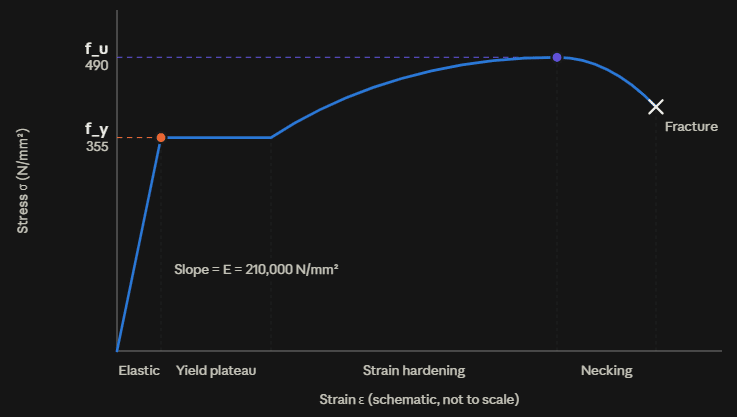
The ultimate strength depends on the thickness of the steel profile. You’ll find the ultimate strength values in EN 1993-1-1 Table 3.1 and at the end of this e-mail.
#4: E-modulus E
The E-modulus together with geometrical properties of the cross-section define the stiffness of steel elements such as beams and columns. Therefore the E-modulus has an effect on the internal forces of statically indeterminate systems like continuous beams and it’s needed to calculate the deflection.
The E-modulus of steel is:
E = 210000 N/mm2
#5: Density ρk
The density is used to calculate the self-weight (dead load) of the structure.
ρk = 78.50 kN/m3
#6 Shear modulus G
The Shear modulus G is also a stiffness property and is used in verifications like torsion, lateral torsional buckling and shear deformation.
The shear modulus of steel is:
G = 81000 N/mm2
#7 Bolt strength classes
The strength of bolts is different to normal steel.
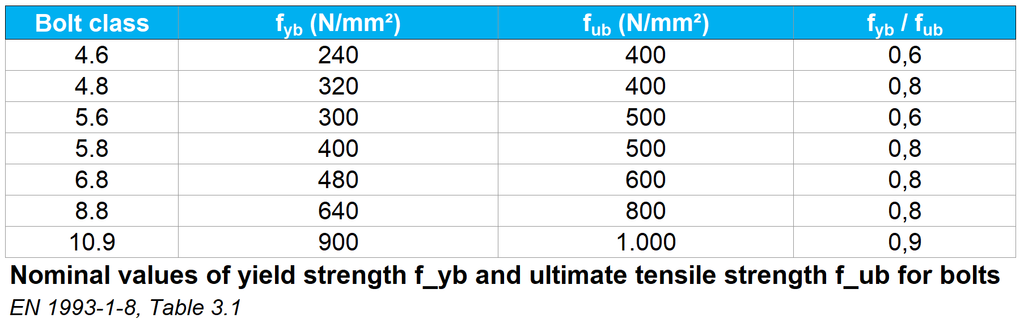
The bolt strength class is a short code, such as 8.8 or 10.9, that tells you the bolt’s strength from two numbers. The classes are defined in EN ISO 898-1 and tabulated in EN 1993-1-8, Table 3.1.
Here’s how to read the strength correctly:
- Multiplying the two numbers by 10 gives the nominal yield strength f_yb. For example, class 8.8 has f_yb = 8 × 8 × 10 = 640 N/mm².
- The first number × 100 is the nominal ultimate tensile strength f_ub in N/mm². For example, 8.x gives 800 N/mm².
- The second number ÷ 10 is the yield-to-ultimate ratio f_yb / f_ub. For example, x.8 means 0.8.
We’ll go into detail how to verify bolted connections in a future newsletter.
Yield Strength fy and Ultimate Strength fu Tables
Here is an overview of the strength capacities of the different steel types and steel thicknesses.
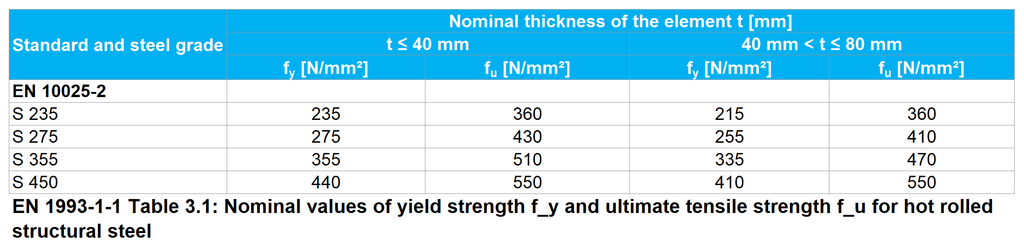
Please be aware that there are many more steel types and variations defined in Table 3.1. But the steels in the table above cover 90% of the steel types I use in buildings.
Final words
These 7 steel properties are not the only ones, but the main ones we use in most design verifications. We don’t want to overcomplicate things in the beginning.
Hope this article helped.
If you don’t want to miss any new structural design tutorials, then subscribe to our free weekly newsletter.
Or subscribe to my YouTube channel for regular updates.
Let’s design better structures together,
Laurin.

Laurin Ernst

![Reinforced Concrete Column Design [2026]](https://www.structuralbasics.com/wp-content/uploads/2024/02/RC-column-design-768x439.jpg)