
Shear Capacity of Timber Connections {Eurocode Tutorial}
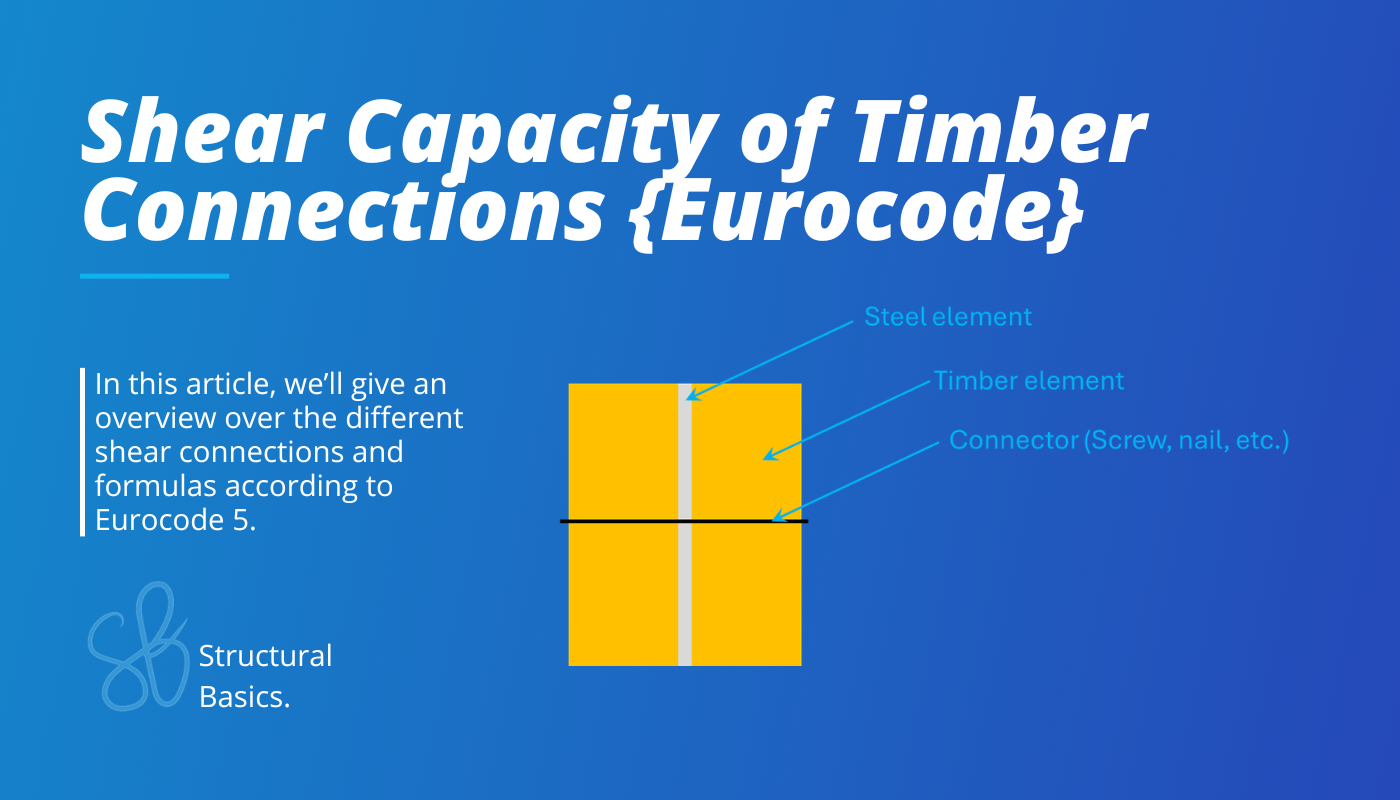
In timber structures the different elements need to be connected with each other.
In most cases these connections are shear connections with either a timber-to-timber or timber to steel connection.
In this article, you’ll get an overview of the different timber shear connections and the verification formulas according to Eurocode.
Now, let’s get into it.
Overview of the Different Shear Connectors According to Eurocode
According to Eurocode we differentiate between
– timber-timber and
– timber-steel connections.
Additionally we differentiate between
– single shear connections and
– multiple shear connections.
Let’s start by looking at timber-to-timber and panel-to-timber connections.
Timber-to-Timber and Panel-to-Timber Connections
Timber-to-timber connections are shear connections which connect either 2 timber elements or multiple timber elements with metal connectors like nails, screws, etc.
Here are all the different failure mechanisms that we need to investigate (EN 1995-1-1 Figure 8.2).
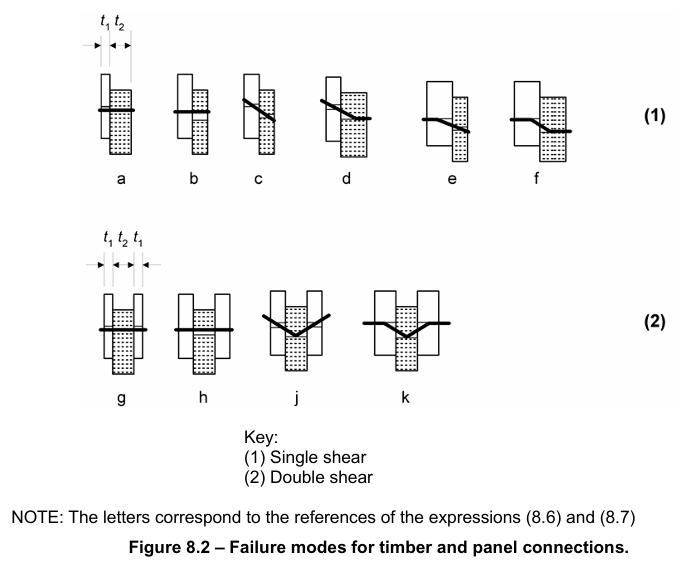
And here are the characteristic shear capacity formulas for these failure modes.
$F_{v,Rk,a} = f_{h,1,k}\, t_1\, d $
$F_{v,Rk,b} = f_{h,2,k}\, t_2\, d$
$F_{v,Rk,c} =\dfrac{f_{h,1,k}\, t_1\, d}{1+\beta} \left[\sqrt{\beta + 2\beta^2\!\left[1 + \dfrac{t_2}{t_1} + \left(\dfrac{t_2}{t_1}\right)^{\!2}\right] + \beta^3\!\left(\dfrac{t_2}{t_1}\right)^{\!2}} – \beta\!\left(1 + \dfrac{t_2}{t_1}\right)\right] + \dfrac{F_{ax,Rk}}{4} $
$F_{v,Rk,d} = 1{,}05\,\dfrac{f_{h,1,k}\, t_1\, d}{2+\beta} \left[\sqrt{2\beta(1+\beta) + \dfrac{4\beta(2+\beta)\,M_{y,Rk}}{f_{h,1,k}\, d\, t_1^2}} – \beta\right] + \dfrac{F_{ax,Rk}}{4} $
$F_{v,Rk,e} = 1{,}05\,\dfrac{f_{h,1,k}\, t_2\, d}{1+2\beta} \left[\sqrt{2\beta^2(1+\beta) + \dfrac{4\beta(1+2\beta)\,M_{y,Rk}}{f_{h,1,k}\, d\, t_2^2}} – \beta\right] + \dfrac{F_{ax,Rk}}{4} $
$F_{v,Rk,f} = 1{,}15\sqrt{\dfrac{2\beta}{1+\beta}}\sqrt{2\,M_{y,Rk}\,f_{h,1,k}\,d} + \dfrac{F_{ax,Rk}}{4}$
$F_{v,Rk,g} = f_{h,1,k}\, t_1\, d $
$F_{v,Rk,h} = 0{,}5\, f_{h,2,k}\, t_2\, d $
$F_{v,Rk,j} = 1{,}05\,\dfrac{f_{h,1,k}\, t_1\, d}{2+\beta} \left[\sqrt{2\beta(1+\beta) + \dfrac{4\beta(2+\beta)\,M_{y,Rk}}{f_{h,1,k}\, d\, t_1^2}} – \beta\right] + \dfrac{F_{ax,Rk}}{4} $
$F_{v,Rk,k} = 1{,}15\sqrt{\dfrac{2\beta}{1+\beta}}\sqrt{2\,M_{y,Rk}\,f_{h,1,k}\,d} + \dfrac{F_{ax,Rk}}{4} $
We cover what the parameters are and how to calculate them in seperate articles.
But if you want to see how to design and verify timber connection on real structures like a timber roof, then I recommend you to check out → Structural Design of a Timber Roof ←.
The book not only explains how to verify the connections, but you’ll also learn how to calculate the loads that act on the connection. You’ll also learn how to design timber rafters, how to do load transfer and much more.
Steel-to-Timber Connections
Steel-to-timber connections are shear connections which connect either one timber element or multiple timber elements with a steel plate with metal connectors like nails, screws, etc.
Here are all the different failure mechanisms that we need to investigate (EN 1995-1-1 Figure 8.3).
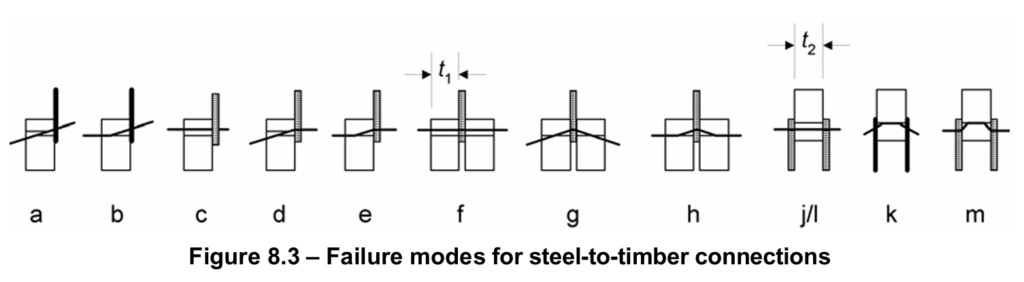
And here are the characteristic shear capacity formulas for these failure modes.
$F_{v,Rk,a} = 0{,}4\, f_{h,k}\, t_1\, d $
$F_{v,Rk,b} = 1{,}15\sqrt{2M_{y,Rk}\, f_{h,k}\, d} + \dfrac{F_{ax,Rk}}{4} $
$F_{v,Rk,c} = f_{h,k}\, t_1\, d \left[\sqrt{2 + \dfrac{4M_{y,Rk}}{f_{h,k}\, d\, t_1^2}} – 1\right] + \dfrac{F_{ax,Rk}}{4} $
$F_{v,Rk,d} = 2{,}3\sqrt{M_{y,Rk}\, f_{h,k}\, d} + \dfrac{F_{ax,Rk}}{4} $
$F_{v,Rk,e} = f_{h,k}\, t_1\, d $
$F_{v,Rk,f} = f_{h,1,k}\, t_1\, d $
$F_{v,Rk,g} = f_{h,1,k}\, t_1\, d \left[\sqrt{2 + \dfrac{4M_{y,Rk}}{f_{h,1,k}\, d\, t_1^2}} – 1\right] + \dfrac{F_{ax,Rk}}{4} $
$F_{v,Rk,h} = 2{,}3\sqrt{M_{y,Rk}\, f_{h,1,k}\, d} + \dfrac{F_{ax,Rk}}{4} $
$F_{v,Rk,j} = 0{,}5\, f_{h,2,k}\, t_2\, d $
$F_{v,Rk,k} = 1{,}15\sqrt{2M_{y,Rk}\, f_{h,2,k}\, d} + \dfrac{F_{ax,Rk}}{4} $
$F_{v,Rk,l} = 0{,}5\, f_{h,2,k}\, t_2\, d $
$F_{v,Rk,m} = 2{,}3\sqrt{M_{y,Rk}\, f_{h,2,k}\, d} + \dfrac{F_{ax,Rk}}{4}$
Final words
Alright, this was a first overview of shear connections in timber design.
I hope this article helped.
If you don’t want to miss any new structural design tutorials, then subscribe to our free weekly newsletter.
Or subscribe to my YouTube channel for regular updates.
Let’s design better structures together,
Laurin.

Laurin Ernst
![Tensile Capacity of Nails [Eurocode]](https://www.structuralbasics.com/wp-content/uploads/2026/01/Tensile-capacity-of-nails-768x439.png)
![5 Timber Roof Structures Explained! [2026]](https://www.structuralbasics.com/wp-content/uploads/2022/01/Timber-roof-structures-768x439.jpg)