Tensile Capacity of Nails [Eurocode]
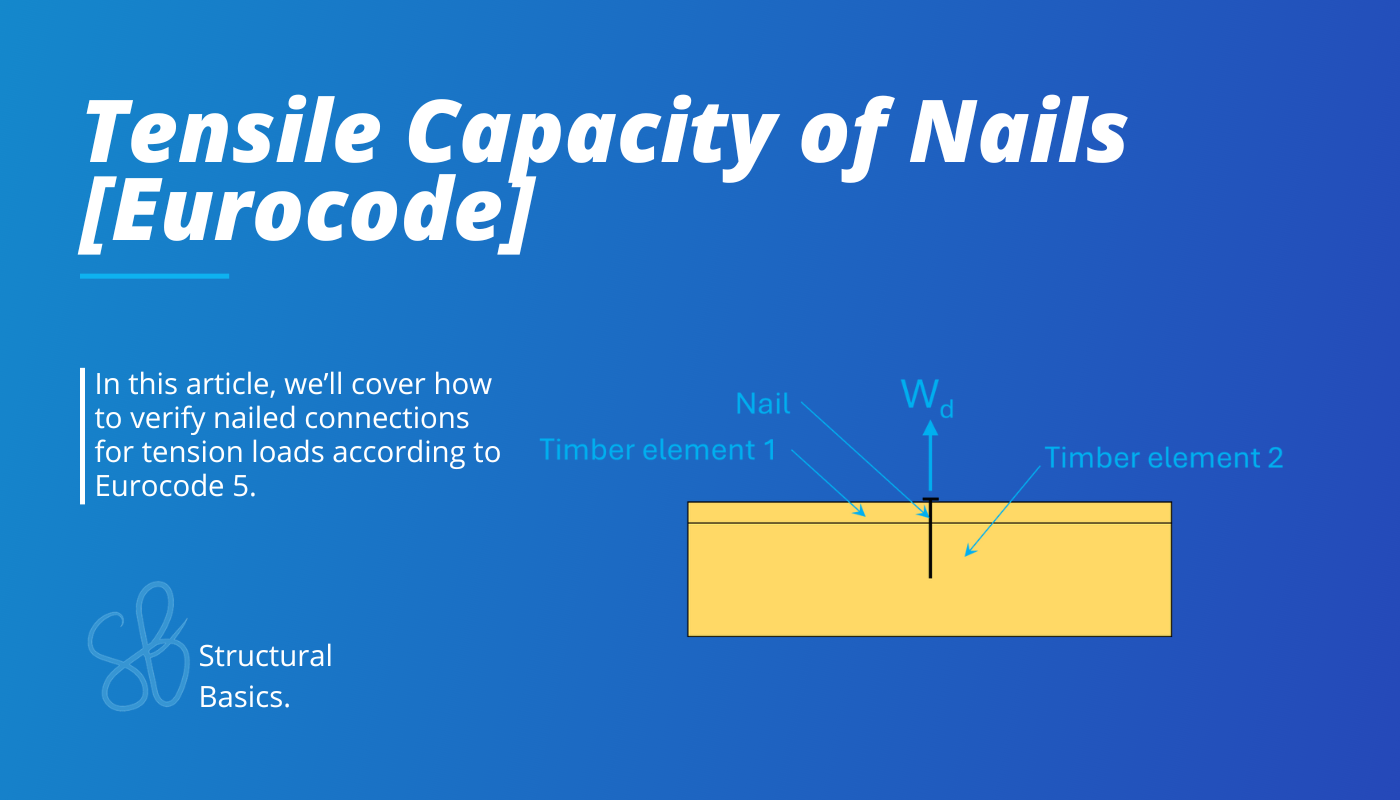
In timber structures nails are often used to connect 2 timber elements like OSB boards with rafters.
In this article, you’ll learn how to verify nailed timber connections for axial loads according to Eurocode.
Now, let’s get into it.
The 4 Steps To Calculate The Tensile Capacity of Nails According To Eurocode
The axial capacity of nails is calculated according to EN 1995-1-1 8.3.2.
According to EN 1995-1-1 8.3.2 smooth nails shouldn’t be used to resist permanent or long-term axial loading. This means nails should only be used for short-term loads like wind loads.
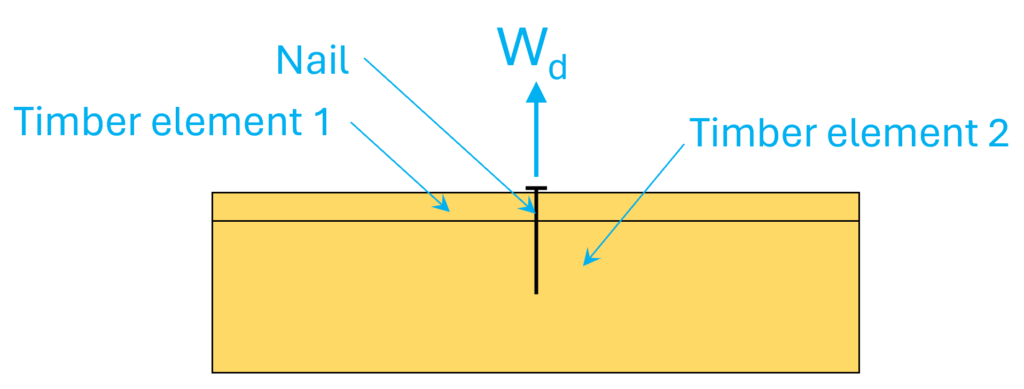
In this article, we’ll calculate the axial capacity of the nailed connection below.
Step #1: Define the geometrical properties of the nails and timber elements
As a screw we use the connector nail ARA4 from Simpson Strong Tie. Nails from Simpson Strong Tie are very common and used in all countries that I have worked in. You can find the data here. The elements have the following dimensions:
- Timber element 1 (OSB): tosb=t1=20mm
- Nail length: ln=75mm
- Pointside penetration thickness in single shear connections (EN1995-1-1 8.3.1.1): t2=ln-tosb=55mm
- Nail diameter d=3.1mm
- Nail head diameter dh=7.5mm
Step #2: Define the material properties of the timber element
We first define the material properties of the OSB boards and the timber rafter.
Here are the strength and stiffness properties that we need in the calculation:
- Density OSB: ρk.osb=550 kg/m3
- Density timber rafter: ρk.r=350 kg/m3
The partial safety factor is found in EN 1995-1-1 Table 2.3 as:
γM = 1.3
The timber elements are classified according to EN 1995-1-1 2.3.1.3 as service class 2 (assumption in this tutorial).
Then we’ll verify the timber beam for a design load of load duration class short-term (EN 1995-1-1 Table 2.1) which leads to a modification factor (EN 1995-1-1 Table 3.1) of:
kmod = 0.9
Step #3: Calculate the loads acting on the nail
In this step we need to calculate the characteristic loads that act on the connector. The characteristic area loads are applied to the slabs like the OSB board and transfered to the connection.
We won’t show how to calculate the loads and how to do the load transfer in this newsletter, as each calculation of the individual load is an article for itself and load transfer is also a big topic.
If you want to learn how to transfer loads correctly from one element like the OSB board to connections like the screws, then I recommend you to check out Module #2. Defining and transfering loads is explained in detail.
→ Click here to read more about it. ←
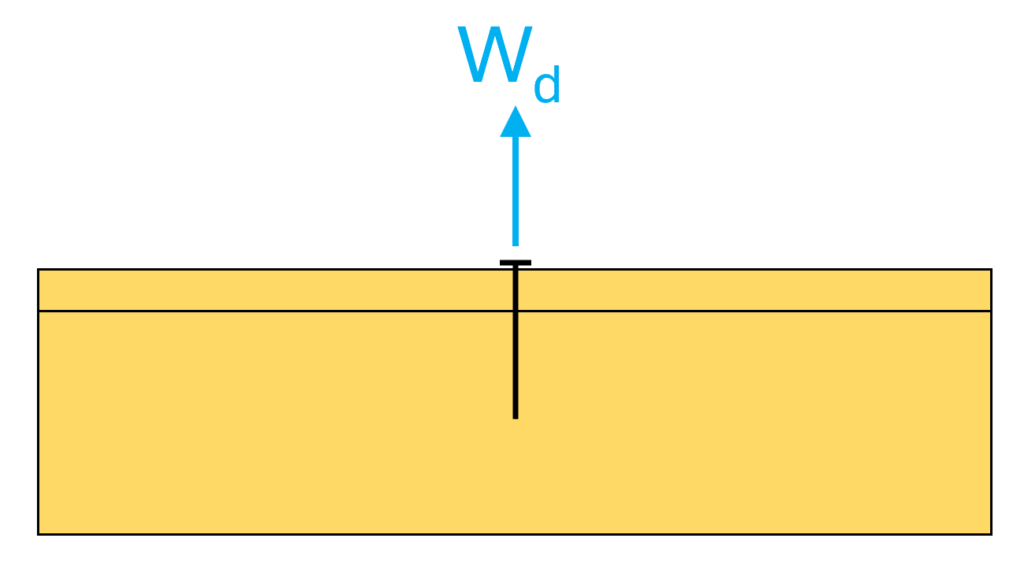
In this email, we’ll verify the nail for the following point load.
Wk = 0.2 kN
Step #4: Axial design verification of the nail
| Characteristic embedment strength for OSB board (EN1995-1-1 (8.22)): | fh.k.1 = 65 ⋅ (d/mm)-0.7 ⋅ (tosb)0.1 N/mm2 = 39.7 N/mm2 |
| Characteristic embedment strength for timber element 2 – rafter (EN1995-1-1 (8.15)): | fh.k.2 = 0.082 ⋅ ρk.r/(kg/m3) ⋅ (d/mm)-0.3 N/mm2 = 20.4 N/mm2 |
| Check if penetration length t2 is smaller than 12d (EN1995-1-1 8.3.2 (7)): | 12d = 37.2mm < t2 -> OK! |
| Minimum density of the 2 timber element: | ρk = min(ρk.osb; ρk.r) = 350 kg/m3 |
| Withdrawal resistance of the nail (EN1995-1-1 (8.25)): | fax.k = 20 ⋅ 10-6 (ρk/(kg/m3))2 N/mm2 = 2.45 N/mm2 |
| Pull-through resistance of the nail (EN1995-1-1 (8.26)): | fhead.k = 70 ⋅ 10-6 (ρk/(kg/m3))2 N/mm2 = 8.6 N/mm2 |
| Characteristic axial resistance for non-smooth nails (EN1995-1-1 (8.23)). If you are using a smooth nail, then use formulas EN 1995-1-1 (8.24): | Fax.Rk = min(fax.k ⋅ d ⋅ t2; fhead.k ⋅ dh2) = 0.42 kN |
| Design withdrawal capacity: | Fax.Rd = kmod ⋅ Fax.Rk/γM = 0.29 kN |
Verification:
η = Wd/Fax.Rd = 0.69
Final words
Alright, this is how design and verify nails for axial loads according to Eurocode.
Hope this article helped.
If you don’t want to miss any new structural design tutorials, then subscribe to our free weekly newsletter.
Or subscribe to my YouTube channel for regular updates.
Let’s design better structures together,
Laurin.

Laurin Ernst

![Reinforced Concrete Column Design [2026]](https://www.structuralbasics.com/wp-content/uploads/2024/02/RC-column-design-768x439.jpg)
![Compression Verification Of Reinforced Concrete [Eurocode]](https://www.structuralbasics.com/wp-content/uploads/2024/10/Compression-verification-of-reinforced-concrete-768x439.jpg)